An Advent Reflection: “Even so, come, Lord Jesus!”

Clouds

[This article was first published in somewhat different form as “Hastening the Day”]

When Christ first came to His own, what caused the majority of His own to reject Him while others received Him gladly and with joy?  What was it that differentiated a Mary, an Elizabeth, a Simeon, or an Anna from the masses that would in thirty plus years cry, “crucify him, crucify him!”?  All were children of Abraham, all had the same Law, read the same prophets, and even believed that a Messiah would indeed come.  So, what differentiated the saints from the serpents at His arrival?

Luke, I believe, gives us the answer in his Gospel account.  When the Christ child, but eight days old, was brought to the Temple for circumcision, we are presented with two saints, each receiving Him joyfully as the expected Messiah. First Simeon:

And behold, there was a man in Jerusalem whose name was Simeon, and this man was just and devout, waiting for the Consolation of Israel, and the Holy Spirit was upon him. And it had been revealed to him by the Holy Spirit that he would not see death before he had seen the Lord’s Christ. (Luke 2:25-26)

Continue reading

“Feminine Deception” and Gregory of Nyssa: An Advent Motif

Jael 2

While reading Joshua Torrey’s A Lying Spirit over the weekend, I began to ponder again Gregory of Nyssa’s view of the Incarnation and Atonement. The fit is quite natural, both considering “holy deception” (as Torrey calls it)—the former explaining and justifying, the latter applying to the cloaking of God in flesh.

Torrey reviews many examples of deception in the Bible, from God employing a lying spirit to deceive a wicked king, to Rahab’s concealment of the Hebrew spies in the City of Jericho, to Solomon’s baby splitting ruse, in each case quoting the approval God and the commendation of Biblical authors. The book itself is set against the backdrop of Project Veritas’s recent public outing of Planned Parenthood’s wicked and disgusting practices. Deception was plainly used in gaining access to the facilities and employees, earning their confidence and gathering information. The question is, were these methods Biblically justifiable? Torrey answers, “yes.” He bases this not only on many in-kind Biblical examples, but in particular on the apparent narrative theme of deception used to despoil the Deceiver, all in order to save life, subvert the forces of injustice, and further God’s own historical redemptive program.

But of most interest to me, relative to Gregory of Nyssa, is Torrey’s observation that,

Continue reading

Why Get All Worked Up About Divine Simplicity? An Introduction to the Importance of the Doctrine

Simple Water

“Hear, O Israel: The Lord our God, the Lord is one!” (Deut. 6:4)

God is not only “one” numerically, He is also one of kind, or better, one without kind; He is the only God and He is not an individual member of a class of like beings, for there is no such class: He is unitas singularitatis. And not only is God one in number, admitting no kind or genus, He is also one in Simplicity; He is unitas simplicitatis. The latter sense of God’s one-ness is what theologians commonly refer to as the doctrine of Divine Simplicity. Stated briefly, the doctrine acknowledges the Biblical truth that God is not composed of parts.

Continue reading

Some Disturbing, Strange, and TMI Musings on God’s Conditional Love, via John Piper

Bethlehem Baptist 2

“Some of God‘s love is unconditional. Some is not. This love is not: ‘He who loves me will be loved by my Father.’ John 14:21” ~John Piper

After reading the above tweet this morning, I was reminded yet again of another illuminating portion of the Desiring God pastors’ conference entitled, “Sanctification by Faith Alone.” We had transcribed a portion of it before, but I think the section from the panel discussion below helpfully fleshes out the meaning and intention of Piper’s tweet. This is by no means intended as a “Gotchya!” quote, but there are nevertheless some disturbing, strange, and even TMI elements. (And to be fair, some very good points re: Michael Card.) I especially like the supposed transition from unconditional love to conditional love after Regeneration.

The following is in answer to the question (paraphrased), “Is God’s love conditional?”

Continue reading

The Invisible Church Relates to the Visible Church as a Part to the Whole

20171126_192304

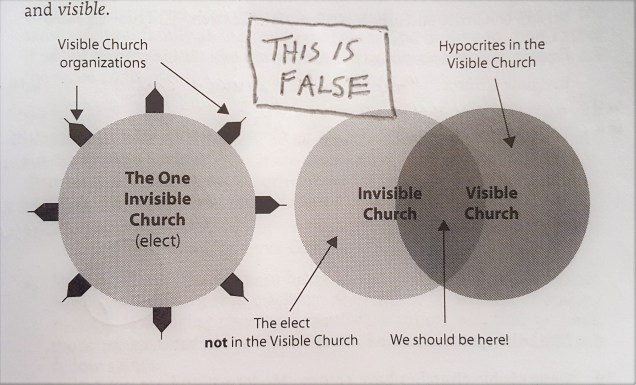
Some people belong to the invisible Church, but are not members of a local visible church. Many people belong to a visible church but are not true believers at all and are thus not in the invisible Church. We must be members of both, by faith in Christ and by confessing Christ. (Norman L. Jones, Study Helps on the Heidelberg Catechism, p. 121)

Now that my third and fourth children are studying through the Heidelberg Catechism in preparation for public confession, my annoyance with the above quoted claim has—well, tripled and quadrupled. I had simply marked “FALSE” on the Venn diagram attending these statements in my first two children’s study guides, but now I am fortunate enough to also contribute to a blog. (Thank you Paul!) And it seems, after asking around, that these statements represent a more common sentiment than I had originally thought. I hope to quickly show below that this is not at all what the Catechism teaches, and more importantly that it is not the teaching of the Scriptures.

Continue reading

Dr. Jones: There is an Answer to “How Many Works Are Necessary?”

blue abstract numbers
blue abstract numbers background

In the recent post, “But How Many Good Works are Necessary?”, Dr. Mark Jones responds to what has probably become a common retort to his insistence that good works are necessary for final salvation. Jones simply believes it is the wrong question altogether, and may even “reveal a legal spirit, not a gospel spirit, that needs mortifying.” I for one think it is a pretty obvious follow up question to being told that good works are necessary for salvation. And I don’t believe this because of “a legal spirit,” or because I am “trying to ignore something glorious” as “one who should know better”; I believe it’s a good question because it is addressed clearly in the Scripture.  Yes, as a matter of fact, it is not only an acceptable question, but it has a Biblical answer.

Continue reading

A Heart & Mouth Wrap-up on the John Piper “Sola Fide” Controversy

collage revised

(^Note the displeased Mr. Luther above.^ Yes…we are still debating Salvation by Faith Alone.)

Well, I think we have written enough on John Piper. I nevertheless thought it might be helpful to collect everything that has been published on Heart & Mouth on the subject into one place, as a shareable resource for the interested. I have also added a short tl;dr for each post below. Lord willing this will allow folks to pick and choose according to their particular interests, or at least grasp at a summary level the arguments that have been made.

One thing should be noted throughout: this debate is not so much with Piper himself, but rather with his Presbyterian and Reformed defenders. John Piper is John Piper, and it seems to me he just makes it up as he goes. The original post that kicked off this debate afresh, “Does God Really Save us by Faith Alone?”, was awful, but par for the course as far as I could tell. The real surprise was how many folks were willing to come out and attack Rachel Miller’s reaffirmation of salvation sola fide in response to Piper. And no, not fellow Bethlehem Baptists, but Presbyterian and Reformed teachers and pastors. It was this that was troubling and demanded response.

Continue reading

Double Justification, Quadruple Justification, and the Defense of John Piper

Hermann_Witsius_by_Heymans

Introduction

We have dealt with various defenses of John Piper’s rejection of Salvation Sola Fide over the last several posts. We first dealt with the claim that he was really just pointing out that Justification and Sanctification are inseparable (HERE). I agree entirely. But both are benefits of union with Christ, faith alone being the instrumental cause of this union. We next looked at the claim the Piper is really just pointing out that “salvation” is a broader term than justification (HERE). I grant this as well, but justification simply is the present declaration of the future verdict, and both are based on the merits of Christ, received by faith alone. And last we responded to Dr. Mark Jones’ rejoinder that Piper is really just infelicitously employing the Reformed Scholastic distinction between Right to Salvation and Possession of Salvation (HERE). We concluded from Thomas Goodwin that the Right to Salvation includes the “whole lump,” not only justification but also final salvation. Justification does not equal Right and final salvation does not equal Possession. There is a right to the whole and a possession of the whole. And the right to the whole lump is had by faith alone.

We come now to another defense that seems to be popping up here and there, particularly via The Calvinist International. The rub seems to be that the best lights of the Reformed tradition have always acknowledged a “Double Justification,” one by faith and the other by works. The implied argument is that Piper is really just talking about these two historically allowable justifications, but modern evangelical and Reformed readers can’t see this, being unaware of the tradition and frightened by words and phrases that don’t fit the modern gloss. But this is absurd. Simply pointing out that there are different senses and uses of the concept “to justify” covers no ground toward solving this dispute. Remember, what is at issue is Piper’s claim that only justification is through faith alone whereas Final Salvation is through faith and fruits, good works being proper conditions and requirements for attaining Heaven (see HERE). So simply pointing out that we can use the word “justify” when speaking of works is irrelevant to the question of whether we are saved now and on the last day by the merits of Christ alone, received by faith alone, or by faith plus “sufficient” fruit.

Continue reading

John Piper: “God never taught Adam or his Second Adam to do the Galatian Heresy”

bethlehem

As folks continue to tell me that John Piper is really just saying what the best lights of the Reformed tradition have always said, I keep thinking of the following transcript. In fact, it was while listening to this Desiring God Pastors’ Conference that I first became fully aware of how far off Piper’s system actually is. I think quoting a portion will make for a nice explanatory addition to my post, “What Precisely is the Disagreement with John Piper?

The following is from the panel discussion at the Conference. The question being discussed is essentially, “What is the difference between your understanding of Sanctification and that of the Puritans, John Owen, J. C. Ryle, or J. I. Packer?” Piper answers,

Continue reading

Salvation Sola Fide: Johannes Wollebius; From Justification to Glorification

Wollebius

This post is a continuation of “Part 3” of the series below, assessing the tradition with respect to John Piper and his defenders:

Rachel Miller Contra Mundum? The 5 Solas and John Piper: Part 1

Rachel Miller Contra Mundum? The 5 Solas and John Piper: Part 2, “Salvation”

Rachel Contra Mundum? The 5 Solas and John Piper: Part 3, Beginning at the End: The Marrow Men

Salvation Sola Fide: Martin Luther and the Fruits of Faith

Salvation Sola Fide: John Calvin and the Causes of Salvation

Salvation Sola Fide: Zacharias Ursinus and the Heidelberg Catechism

Salvation Sola Fide: Johannes Wollebius; Justification to Glorification

While not very well known today, the Compendium Theologiae Christianae by Johannes Wollebius (1589-1629) was a standard textbook at Yale and Harvard in the 17th and 18th centuries, and according to the Encyclopedia of the Reformed Faith was also quite influential in the development of the Westminster Larger and Shorter Catechisms. Wollebius’ work in the Compendium was and is considered by many to be an accurate summary of the teaching of the Reformed churches in the early part of 17th century, the very period of the Synod of Dort.

Since in this series we are discussing “salvation” broadly considered, we will begin with Wollebius’ teaching on Justification and then follow on to Sanctification, good works, and the Final Judgement. It is important to note that once Justification is accurately understood, many of the following doctrines are pretty simple.

Continue reading