Why Racism is Material Heresy and Ought to be Formal Heresy : Outline 1

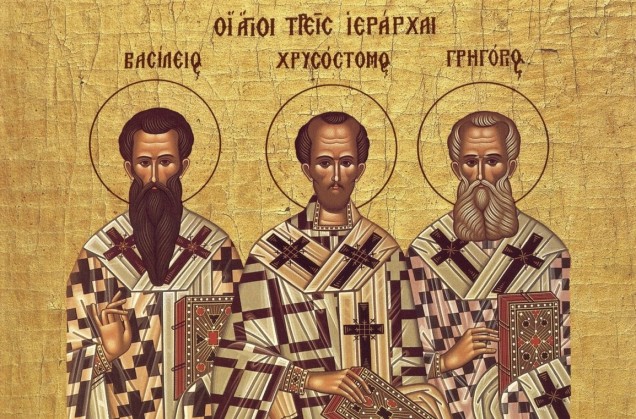
Cappadocians 1

[Many, upon reading this piece, have noted that there is no formal definition of “racism” or even “race” included. This is by design, though I see that it could be confusing. Defining “racism” as such is admittedly difficult and would alone constitute matter for an essay much longer than even what appears here; and even if that were accomplished, there would still remain much disagreement. Therefore, the approach of these outlines is to target and identify specific claims that most would acknowledge as “racist,” regardless of how fuzzy the edges of the set of ideas in question may be. For example, this outline deals only with claims of superiority or inferiority between races (as per Martin Luther King, Jr.’s, “myth of inferior peoples”). If one’s specific brand of racist ideology does not include nor imply a claim of superiority or inferiority, then clearly this post does not capture that specific ideology. (Though arguments of implication may often be successfully employed to demonstrate that superiority/inferiority is in fact being claimed, though not directly. For some historical definitions of “racism,” see HERE.)

Further, the concept “race” itself is not defined, but for much the same reasons. The argument of this particular outline proceeds on the assumption that if one believes and confesses superiority or inferiority among races also is assuming that there is such a thing as “race”; this does not logically imply that there is in fact such a thing as “race” (though I think the concept is legitimate and useful if handled correctly as a social construction and as colloquially employed). The reader will see below that, working with the understanding of one who claims superiority/inferiority, race would minimally (not maximally!) include common progeneration. So, rather than defining the term, given abundant disagreement, I assume only what would be minimally included by one who would employ the term to claim superiority/inferiority. (For a helpful discussion of “race,” see HERE.)

And last, the reader should note that there is no specific race or ethnicity targeted in what follows; any claim by anyone that any race can be superior or inferior to any other falls within the scope of criticism below.]
Continue reading

Thomas Aquinas on the Obedience of the Son (re: “The Obedience of the Eternal Son,” Part 3)

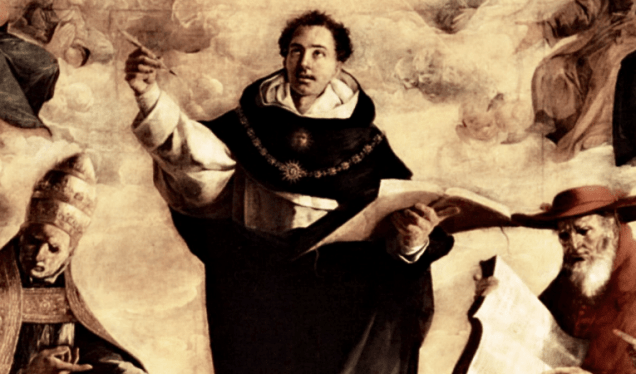
Apotheosis-of-St.-Thomas-Aquinas

Introduction

After questioning the motivation for the essay “The Obedience of the Eternal Son” in my first post, and then justifying my representation of the essay in the second, we are now in a position to enter into the substance of the discussion. But rather than continue with polemics, I have decided to take a piece of advice from Dr. Michael Allen and engage more constructively. (Plus, very few of my readers are even familiar with the essay under consideration as it is not easily linkable.) I do intend to continue questioning the thesis of the so-called “obedience of the eternal Son,” but rather by presenting what I believe to be an accurate representation of the Biblical data, and then comparing several alternate claims, concluding with an assessment of Drs. Swain and Allen’s parrying of the objections of Thomas Joseph White to their thesis.

As the work of Thomas Aquinas is the primary resource for Swain and Allen’s coordination of “the obedience of the eternal Son” with “traditional trinitarian metaphysics in the classical Catholic and Reformed tradition,” I will accordingly present what I perceive to be the Catholic and Reformed tradition as found in Aquinas’s Summa Theologiae.

Continue reading

Some Questions re: “The Obedience of the Eternal Son”: Part 2, Clarifications and Justifications

Chalcedon

What Should Be Clear

Though I did intend in the first post of this series to disagree with Swain and Allen’s essay, “The Obedience of the Eternal Son,” I certainly did not want to misrepresent it. I think I have stated clearly that neither Scott Swain nor Michael Allen held to the Eternal Functional Subordination of the Son (EFS), nor was their essay intended to support it. It would make no sense in the context of their piece to argue that they did. The point of their essay was to show a path such that one could affirm the obedience of the eternal Son of God without succumbing to such ahistorical revisions of Trinitarian doctrine and metaphysics as found in EFS. They refer specifically the specter of identifying “obedience as the Son’s distinguishing personal property (usually identified as the Son’s ‘role’ in the Trinity),” pointing to Grudem and Ware in the footnote (p. 74).  Further, an eternal “functional” obedience would fare no better on these terms since the constant assumption throughout the piece is that one cannot divide the Being and acts of the Son of God.

Continue reading

Some Questions re: Swain and Allen’s “The Obedience of the Eternal Son”: Part 1, Barth’s Challenge

karl_barth 2

I must note at the outset: Swain and Allen explicitly reject ESS, EFS, and ERAS as presented by Wayne Grudem and Bruce Ware. Further, nothing below is meant to suggest that they have in fact adopted the Barthian program or are themselves “Barthians.” And I also must include the obligatory (and accurate), “I am no expert on Barth, but…”. I am far from it.

I have been mulling over Scott R. Swain and Michael Allen’s article “The Obedience of the Eternal Son” for quite some time now, having had mixed feelings. Plus, I don’t really see myself well positioned to critique such better lights as these. (In fact, if you haven’t read Reformed Catholicity: The Promise of Retrieval for Theology and Biblical Interpretation by Swain and Allen, I would suggest clicking out of this article and ordering now.) Nevertheless, as proponents of Eternal Subordination of the Son seem to be finally adopting the doctrine of Eternal Generation, and are now beginning to use the doctrine as the basis for ascribing obedience to the Son in eternity, I’ve decided to at least ask few questions over the next couple of posts.

Continue reading

Remember Calvinists: God Became Man For All Mankind

With Christmas only four days away, I fear that many so-called “Calvinists” inadvertently limit the joy, comfort, and grandeur of the celebration by inadvertently limiting the scope of the Incarnation itself. Christmas is not just for the elect. The event to be celebrated brings with it a message of redemption to any and all who will hear and believe. “This is a faithful saying and worthy of all acceptance, that Christ Jesus came into the world to save sinners, of whom I am chief” (1 Tim. 1:15). The very nature of the Incarnation itself assures us of the universal right to forgiveness of sins and eternal life to all who would hear and believe the Gospel of our Lord’s birth, death, and resurrection. And this should be of great comfort, not only to the believer’s own fearful heart, but to all of God’s image bearing creatures: “Believe on the Lord Jesus Christ and you will be saved” (Acts 16:31).

This message is encapsulated in (probably) the most famous and oft quoted passage, John 3:16: “ For God so loved the world that He gave His only begotten Son, that whoever believes in Him should not perish but have everlasting life.” In it, we see the motivation for the great Christmas event (God’s love), the event itself (God gave), and the universal nature of the message it proclaims (whoever).

Continue reading

Why Get All Worked Up About Divine Simplicity? An Introduction to the Importance of the Doctrine

Simple Water

“Hear, O Israel: The Lord our God, the Lord is one!” (Deut. 6:4)

God is not only “one” numerically, He is also one of kind, or better, one without kind; He is the only God and He is not an individual member of a class of like beings, for there is no such class: He is unitas singularitatis. And not only is God one in number, admitting no kind or genus, He is also one in Simplicity; He is unitas simplicitatis. The latter sense of God’s one-ness is what theologians commonly refer to as the doctrine of Divine Simplicity. Stated briefly, the doctrine acknowledges the Biblical truth that God is not composed of parts.

Continue reading

The Invisible Church Relates to the Visible Church as a Part to the Whole

20171126_192304

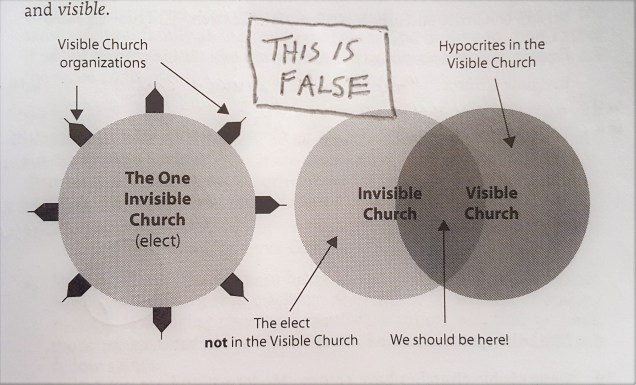
Some people belong to the invisible Church, but are not members of a local visible church. Many people belong to a visible church but are not true believers at all and are thus not in the invisible Church. We must be members of both, by faith in Christ and by confessing Christ. (Norman L. Jones, Study Helps on the Heidelberg Catechism, p. 121)

Now that my third and fourth children are studying through the Heidelberg Catechism in preparation for public confession, my annoyance with the above quoted claim has—well, tripled and quadrupled. I had simply marked “FALSE” on the Venn diagram attending these statements in my first two children’s study guides, but now I am fortunate enough to also contribute to a blog. (Thank you Paul!) And it seems, after asking around, that these statements represent a more common sentiment than I had originally thought. I hope to quickly show below that this is not at all what the Catechism teaches, and more importantly that it is not the teaching of the Scriptures.

Continue reading

Dr. Jones: There is an Answer to “How Many Works Are Necessary?”

blue abstract numbers
blue abstract numbers background

In the recent post, “But How Many Good Works are Necessary?”, Dr. Mark Jones responds to what has probably become a common retort to his insistence that good works are necessary for final salvation. Jones simply believes it is the wrong question altogether, and may even “reveal a legal spirit, not a gospel spirit, that needs mortifying.” I for one think it is a pretty obvious follow up question to being told that good works are necessary for salvation. And I don’t believe this because of “a legal spirit,” or because I am “trying to ignore something glorious” as “one who should know better”; I believe it’s a good question because it is addressed clearly in the Scripture.  Yes, as a matter of fact, it is not only an acceptable question, but it has a Biblical answer.

Continue reading

What Precisely is the Disagreement with John Piper?

plug in

I have received multiple comments over the last two weeks that prove I have not been nearly as clear as I’d hoped to be with reference to John Piper and Salvation Sola Fide. (I am a pretty rough writer, I know.) They are generally of the sort, “Piper does not teach that we are Justified by works, but by faith alone,” or “Piper says all the time that good works are simply the fruits and evidences of faith, just like we do,” or “Piper teaches that all who are Justified will in fact be saved on the Last Day—no exceptions.” What makes this so difficult is that I agree with each of these statements. I have never questioned these nor claimed that Piper thinks otherwise. Though we do disagree in some measure on the meaning of the terms, and explicitly on the implications of the concepts, I am positive that all in this discussion agree on the following very important propositions:

Continue reading

Rachel Miller Contra Mundum? The 5 Solas and John Piper, Part 2: “Salvation”

Reformation

A quick note on our previous post, Part 1. It seems that many take exception to Ursinus’ use of the word “regeneration.” I am not suggesting we change our current use, but rather just pointing out that when we read what he has written on the subject, Regeneration is used simply to denote all that is the second benefit in the duplex gratia. It represents all that answers to our corruption received from Adam in distinction to our guilt derived from the same. And this was the common usage of the word prior to the tidier ordering and parsing of benefits that came later.  For example, Witsius writes,

For really, sanctification differs no other ways from the first regeneration and renovation, than as the continuance of an act differs from the beginning of it. (Bk. 3.8.10)

And as to the concern that Ursinus is saying faith precedes Regeneration in time, that is not at all what he is saying. Rather, the Holy Spirit is working Regeneration when He works faith in the heart. As the Catechism says,

Q.65. Since, then, we are made partakers of Christ and all His benefits by faith only, where does this faith come from?

The Holy Spirit works faith in our hearts by the preaching of the Holy Gospel, and confirms it by the use of the holy sacraments.

Continue reading