Correcting (my own) Normativity of Whiteness, Conclusion: From “Racial Biology” to “White Supremacy”

Mankind1ma6

[For needed context, please see the previous posts, “Correcting (my own) Normativity of Whiteness: 1. From the Arrival of the First African Slaves to ‘Partus Sequitur Ventrem’” and “Correcting (my own) Normativity of Whiteness: 2. From Bacon’s Rebellion to ‘White Men’ and ‘White Women’.”]

Thus far, we have witnessed the movement from a disparate group of indentured servants—originating from various European and African nations, working side by side in the English Colonies—into a bifurcation of (1) “white men” and “white women” and (2) “Negroes, Mulattos, and Indians.” Through the developing legal code, we have also seen the class “white” receive legal protections and privileges while the class “Negro and Mulatto” alone became subjects of life-long chattel slavery—they and their children.

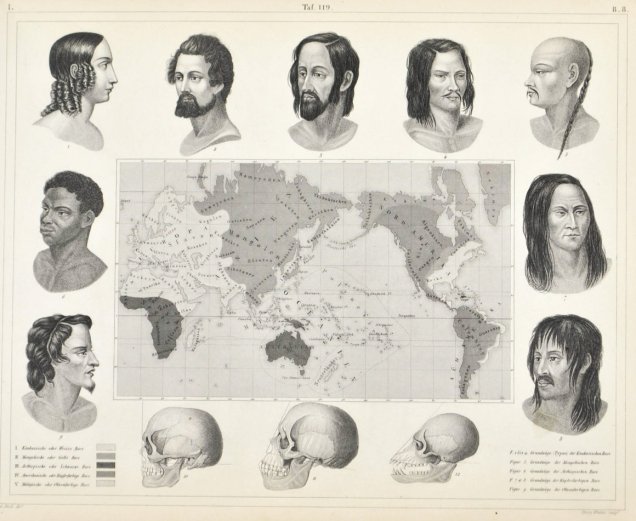
As stated at the end of the last post, the only element lacking in the construction of the “white race” by 1723 was the concept of “race” itself. We will now briefly turn to this, though with an eye to our purposes rather than the details of the “science” itself, its definitions, etc. We will then move on to the post-Revolutionary era and conclude with some application.
Continue reading

Correcting (my own) Normativity of Whiteness: 2. From Bacon’s Rebellion to “White Men” and “White Women”

bacons-rebellion

[Please see the previous post, “Correcting (my own) Normativity of Whiteness: 1. From the Arrival of the First African Slaves to ‘Partus Sequitur Ventrem’,” for needed context.]

In what follows, we continue to consider the construction of the “white race” and “whiteness” as developed in Colonial American history. As noted before, there simply was no such thing as “white people” prior to the 17th century. We have already witnessed how, through legal changes, a disparate group of indentured servants from various European and African nations, working side by side at the beginning of the 17th century, were transformed into roughly two groups, (1) “Christians” and those from “Christian nations,” receiving legal protections, and (2) those imported from non-“Christian” nations, comprising (with few exceptions) those of African descent alone—and their children. The latter increasingly became subjects of life-long servitude, while the former were granted more and more legal protections and comparative privileges. But as we have also seen, once conversion to Christianity was legally clarified to not require manumission, new lines of demarcation and categorization were needed to maintain the social control system necessary for a slave-based economy, wherein a few wealthy land-holders employed with scraps and chains an overwhelmingly large labor class.

And possibly more than any other event, Bacon’s Rebellion made clear to Virginia’s leadership the necessity of new lines of demarcation among these laboring people groups. To this we will now turn.

Continue reading

Correcting (my own) Normativity of Whiteness: 1. From the Arrival of the First African Slaves to “Partus Sequitur Ventrem”

Partus edit
GLC 5111.02.1051. Issac & Rosa. Photograph: Two young slave children, boy and girl arm in arm, n.d. (The Gilder Lehrman Collection, courtesy of the Gilder Lehrman Institute of American History. Not to be reproduced without written permission.)

[I do intend to return to my series, “What Is & Isn’t Being Said,” but have chosen to pause for some clarifications. Thus far, the clarifications have included, “Racism Isn’t the Problem, Sin is the Problem!” and “What Does ‘Jew & Gentile’ Have to do With ‘Black & White’?” The following is a further clarification, specifically of Post 2 in the series.]

Having previously discussed the invention of the so-called “Black Race,” cobbled together from various ethnicities, tribes, languages, and nations—for the very purpose of subjugation—I have since recognized a gaping hole in my analysis of the “color-line” as developed in Western history. Presumably due to my own sense of “White Normativity,” I had treated the so-called “White Race” as an historical given, rather than itself likewise a created hodge-podge of differing ethnicities, tribes, languages, and nations—but in this case, for the very purpose of supremacy. I intend to correct that in these clarification posts. I will focus mainly on the English colonies of Virginia and Barbados, each being important representatives of the development of Atlantic slavery and the resulting concept of “whiteness.”

What follows is a simple time-line approach, including primary sources, to the end that we might see clearly the transition from an original group of disparate national and ethnic colonial laborers to a protected white class, accorded all the eventual privileges of American society, intentionally separated from the class of disenfranchised laborers, viz., primarily brown and black Americans. To be sure, there was no such thing as “white people” prior to the 17th century. In fact, the “races,” as we know them, were constructed in the very process of creating, maintaining, and justifying the otherwise unjustifiable practice of race-based chattel slavery.

Continue reading

Then & Now: The Conservative Presbyterian Race Debate in 1964

Oliver collage 4

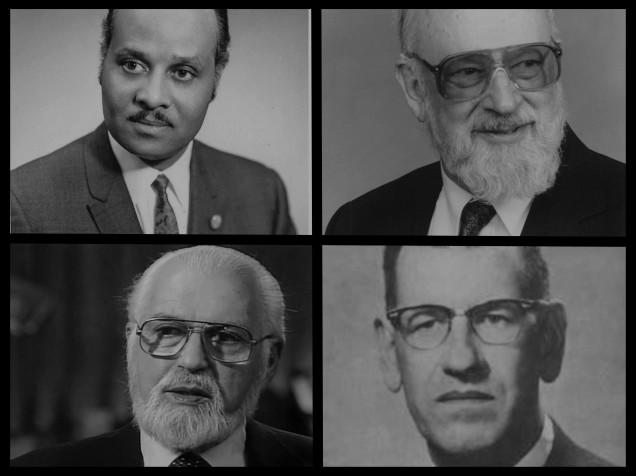
In this article, I hope to give some idea of the state of the race debate among conservative Presbyterians, especially those associated with the Orthodox Presbyterian Church (OPC) and those who would later form the Presbyterian Church of America (PCA), just following the passage of the Civil Rights Act in 1964. This will be done through the lens of The Presbyterian Guardian and will feature a discussion of C. Herbert Oliver’s articles condemning segregation, Morton H. Smith’s article defending segregation, and letters to the editor written by R. J. Rushdoony, E. J. Young, and other Reformed and Presbyterian believers of the day. My hope is that as we reflect on these articles and the state of the debate in 1964, we will see that while much has changed, much of the opposition has remained the same.

Continue reading

What Does “Jew & Gentile” Have to do With “Black & White”? : A Clarification

Crowd_divided

Please see the previous post, “‘Racism Isn’t the Problem, Sin is the Problem!’ : A Brief Clarification,” for some needed context for what follows here.

What Does “Jew & Gentile” Have to do With “Black & White”?

The Jew/Gentile conflict throughout the New Testament is often either (1) leveraged to prove there should be no recognition of race and ethnicity in Christ (“no Jew, no Gentile”), or (2) is denied to have anything to do with race and ethnicity since it is properly a covenantal/religious conflict. Others—those I’d agree with—see this conflict as an indispensable Biblical example of both definitive unity in Christ and a call to seek progressively lived unity in the Body. I hope, in what follows, to provide some clarity to the similarities and differences between the New Testament Jew/Gentile conflict and the White/Black conflict we have inherited in the United States.

Continue reading

“Racism Isn’t the Problem, Sin Is the Problem!” : A Brief Clarification

seeing-clearly

A few questions have come up over and over while discussing the issue of racial and ethnic reconciliation, so I’ve thought it best to pause my “What Is & Isn’t Being Said” series to offer some brief clarifications. Each should be taken quite narrowly, as addressing only that which is mentioned. E.g., below, this clarification does not address the wider social applications beyond the body of Christ, which will be addressed later. It also does not address the history of those who knew and preached the gospel, yet nevertheless promoted, defended, and preserved racist ideas.

“Racism Isn’t the Problem, Sin Is the Problem!” : A Brief Clarification

The problem isn’t ‘racism’, or any other ‘ism’ for that matter, but the congenital sin nature we each bear in our heart. The gospel makes this perfectly clear, particularly in Mark 7:17-23. Racism is ‘dealt with’ the same as any other sin. This is not rocket science, folks. SMH! (Darrell B. Harrison via Twitter)

I do not intend to pick on Mr. Harrison in particular, but his statement above does reflect a common sentiment among evangelicals. “Racism isn’t the problem, sin is the problem, and only the gospel can change the heart”; or, “racism is sin, and the only remedy for sin is the gospel.” Statements such as these seem quite correct on the surface. It is certainly true that all sin is from the heart. It is also true that only Jesus can change the heart. And it is true that the gospel is the only ultimate remedy for sin. But it seems odd, at least to me, to then conclude that a retelling of the gospel—in most evangelical cases narrowly defined as something like the incarnation, death, and resurrection of the Son of God—is the only remedy to be applied, or even suggested, and that little to no detailed discussion, research, or acknowledgement of specifics is required. We certainly don’t do this with other sins that plague the Church.

Continue reading

History, Justice, and Gospel: A Couple Reflections on John MacArthur’s Post #5

white priv 2

[To be 100% clear, I do not believe that John MacArthur would agree with the image above, nor have anything but condemnation for its message. I have only used this image to reflect the attitude of many American Christians throughout our history. The image is about the content below, not John MacArthur.]

Though John MacArthur’s most recent article on Racial Reconciliation (RR) continues to rely mostly on innuendo with no attempt to connect the dots, “this sounds like that so it must be that” type reasoning, and reads more like baptized conservative politics, there are nevertheless two points I would like to briefly respond to here.

Continue reading

No, John MacArthur, RR Advocates Are Not Just “Ensnared in Efforts to Please the Culture”

JMac Church

Pastor John MacArthur posted the fourth installment in his celebrated series on “social justice” and Racial Reconciliation (RR) Wednesday evening, “Is the Controversy over ‘Social Justice’ Really Necessary?” First, on a positive note, pastor MacArthur writes,

As Christians committed to the authority of Scripture and the truth of the gospel, we have better answers than the world could ever give to the problems of racism, injustice, human cruelty, and every other societal evil. We have the cross of Jesus Christ, and the Holy Spirit who grows and leads us in all love, joy, peace, patience, kindness, goodness, faithfulness, gentleness, and self-control (Galatians 5:22-23).

To which I say Amen and Amen! This, I believe, every Christian in the discussion can and should agree with.

But unfortunately, like the three that had gone before, there is very little substance and no arguments provided to support the critical claims of this fourth post—Biblical or otherwise—so there is still not much to interact with. What he does mention (but not substantiate) has been handled in many other articles already. He states, e.g., that “The American attitude has changed. White supremacy and all other expressions of purposeful, willful, or ideological racism are almost universally condemned”; if anything, we have already gone too far in response. I would simply suggest reading, “What Is & Isn’t Being Said: 6. ‘Color-Blind Racism’.”

Continue reading

What Is & Isn’t Being Said: 6. “Color-Blind Racism”

More frames adjusted

Having shown in the last post that color-blindness is not in fact a Biblical ethic, we now move on to the concept of “color-blind racism.”

If one is willing and able to believe the research outlining the great racial disparities in American society today—in terms of wealth, home ownership, employment, education, health, criminalization, incarceration, etc.—as well as the persistent de facto neighborhood and church segregation, one is compelled to seek an explanation. In broad terms, Americans are either inclined to interpret this data as the modern manifestation and continuation of 450 years of slavery and oppression leading to racism, discrimination, and attempted dehumanization of the “black race” at the hands of the white, or they are inclined to look for explanations in the very nature and behavior of the victims themselves. Those who find the former explanation persuasive are likely committed to the essential and fundamental equality of the races; any explanation that regards or implies the superiority or inferiority of any racial group is in fact a false, racist, mythology.

On the other hand, those who would adopt the latter explanation, that black Americans are themselves either wholly or largely responsible for their own plight, have proven the majority throughout American history, even in the midst of antebellum slavery and Jim Crow. Continue reading

What Is & Isn’t Being Said: 5. “Color-Blind Theology”

greyscale

[I found it necessary later to offer one clarification to what follows. Though mentioned below, I want to make it abundantly clear that I do not think that the Jew/Gentile relation is one-to-one comparable to modern Western racial relations, but am only here responding in-kind to those who would press color-blindness via the passages discussed. Please see “What Does “Jew & Gentile” Have to do With “Black & White”? : A Clarification.]

Among the greatest barriers to acknowledging—or even recognizing—the extent of racialization in American society, and the extent of white privilege in particular, is the post-Civil Rights ethic of “color-blindness.”

Not only does the color-blind ethic obscure the history and currency of the centuries-forged “color line” in America, it also allows for only historically unhinged explanations of current disparities, lending to the continued maintenance of the status quo, cemented through 450 years of both overt racism and racialized institution building. In fact, it renders racial and ethnic disparities nearly un-stateable, collapsing all problems into individual events among individual bad actors with “perfectly reasonable” individual explanations—usually some deficiency among minorities themselves.

While I intend to explore the interpretive patterns and social ramifications of color-blind racism in the next post, I would like here to first address the so called “color-blind theology” which is thought to furnish a Biblical justification for a color-blind ethic within the Church itself. Just as the majority of Americans today believe color-blindness to be the highest expression of anti-racism, so also many theologians seem to believe it is the God ordained basis for unity within the Church as well as the Gospel cure to any prejudice or disparity within the Body.

Continue reading