On June 16, 1858, Abraham Lincoln delivered his “House Divided” speech to the gathered Republican Party:
A house divided against itself cannot stand. I believe this government cannot endure, permanently, half slave and half free. I do not expect the Union to be dissolved—I do not expect the house to fall—but I do expect it will cease to be divided. It will become all one thing or all the other. Either the opponents of slavery will arrest the further spread of it, and place it where the public mind shall rest in the belief that it is in the course of ultimate extinction; or its advocates will push it forward, till it shall become lawful in all the States, old as well as new—North as well as South.
Just a few months following, future president of the Confederate States Jefferson Davis offered his own perspective on this brewing divide within the United States, laying the fault solely in the lap of Northern abolitionist agitation:
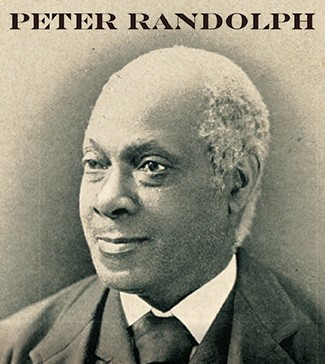
In his autobiography, From Slave Cabin to the Pulpit, Rev. Peter Randolph (1825 – 1897) answers the claim that slavery was good for the African, freeing him from the bonds of paganism, bringing him to Gospel salvation. To be sure, there was a “gospel” preached to them; but was it the true Gospel of our Lord Jesus Christ, or a truncated facsimile, bastardized for the sake of exploitation?
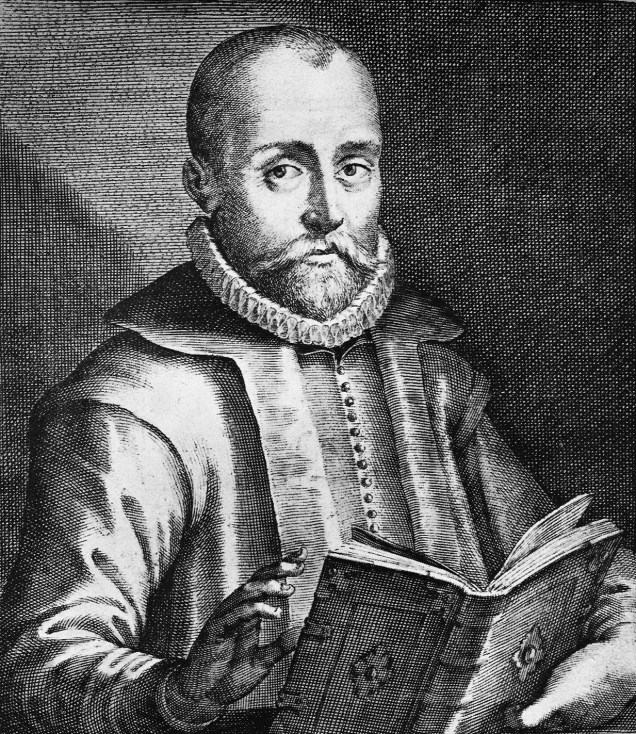
The Puritans believed, too, in civilizing and Christianizing the world, but their approach to the project was slightly different from that of most explorers and expedition sponsors. For the others, it was about economic returns or political power. For Puritan preachers, it was about bringing social order to the world. Cambridge professor William Perkins rested at the cornerstone of British Puritanism in the late sixteenth century. “Though the servant in regard of faith and the inner man be equal to his master, in regard of the outward man… the master is above the servant,” he explained in Ordering a Familie, published in 1590. In paraphrasing St. Paul, Perkins became one of the first major English theorists—or assimilationist theologians, to be more precise—to mask the exploitative master/servant or master/slave relationship as a loving family relationship. […] It was Perkins’s family ordering that Puritan leaders like John Cotton and Richard Mather used to sanction slavery in Massachusetts a generation later. And it was Perkins’s claim of equal souls and unequal bodies that led Puritan preachers like Cotton and Mather to minister to African souls and not challenge the enslavement of their bodies. (Kindle location 581)
Thus far, we have witnessed the movement from a disparate group of indentured servants—originating from various European and African nations, working side by side in the English Colonies—into a bifurcation of (1) “white men” and “white women” and (2) “Negroes, Mulattos, and Indians.” Through the developing legal code, we have also seen the class “white” receive legal protections and privileges while the class “Negro and Mulatto” alone became subjects of life-long chattel slavery—they and their children.
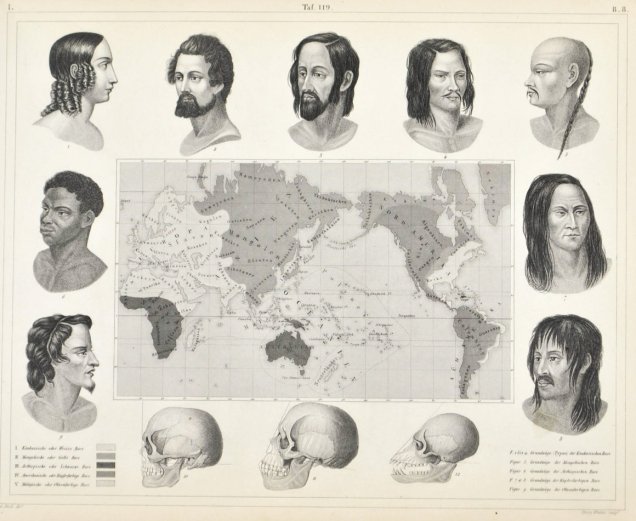
As stated at the end of the last post, the only element lacking in the construction of the “white race” by 1723 was the concept of “race” itself. We will now briefly turn to this, though with an eye to our purposes rather than the details of the “science” itself, its definitions, etc. We will then move on to the post-Revolutionary era and conclude with some application.
In what follows, we continue to consider the construction of the “white race” and “whiteness” as developed in Colonial American history. As noted before, there simply was no such thing as “white people” prior to the 17th century. We have already witnessed how, through legal changes, a disparate group of indentured servants from various European and African nations, working side by side at the beginning of the 17th century, were transformed into roughly two groups, (1) “Christians” and those from “Christian nations,” receiving legal protections, and (2) those imported from non-“Christian” nations, comprising (with few exceptions) those of African descent alone—and their children. The latter increasingly became subjects of life-long servitude, while the former were granted more and more legal protections and comparative privileges. But as we have also seen, once conversion to Christianity was legally clarified to not require manumission, new lines of demarcation and categorization were needed to maintain the social control system necessary for a slave-based economy, wherein a few wealthy land-holders employed with scraps and chains an overwhelmingly large labor class.
And possibly more than any other event, Bacon’s Rebellion made clear to Virginia’s leadership the necessity of new lines of demarcation among these laboring people groups. To this we will now turn.
GLC 5111.02.1051. Issac & Rosa. Photograph: Two young slave children, boy and girl arm in arm, n.d. (The Gilder Lehrman Collection, courtesy of the Gilder Lehrman Institute of American History. Not to be reproduced without written permission.)
Having previously discussed the invention of the so-called “Black Race,” cobbled together from various ethnicities, tribes, languages, and nations—for the very purpose of subjugation—I have since recognized a gaping hole in my analysis of the “color-line” as developed in Western history. Presumably due to my own sense of “White Normativity,” I had treated the so-called “White Race” as an historical given, rather than itself likewise a created hodge-podge of differing ethnicities, tribes, languages, and nations—but in this case, for the very purpose of supremacy. I intend to correct that in these clarification posts. I will focus mainly on the English colonies of Virginia and Barbados, each being important representatives of the development of Atlantic slavery and the resulting concept of “whiteness.”
What follows is a simple time-line approach, including primary sources, to the end that we might see clearly the transition from an original group of disparate national and ethnic colonial laborers to a protected white class, accorded all the eventual privileges of American society, intentionally separated from the class of disenfranchised laborers, viz., primarily brown and black Americans. To be sure, there was no such thing as “white people” prior to the 17th century. In fact, the “races,” as we know them, were constructed in the very process of creating, maintaining, and justifying the otherwise unjustifiable practice of race-based chattel slavery.
As I continue to work through my series on Racial Reconciliation, I’ve decided to keep up with some more basic theological content in the meantime. I hope to get at least one of these up per week.
“Religion” has become a bad word in much of modern evangelicalism. We are told that “religion” disrupts relationship with God, or that “religion” is man’s creation and therefore is somehow man-centered and not God-centered. On the other hand, the Reformed have always contended that religion is itself inescapable; all men are religious, whether they like it or not. That is, religion is universal. It is very much a part of being human, being made in the image of God. Further, I will argue that “pure religion and undefiled before God” (Jas. 1:27) is neither purely intellectual nor purely practical, but brings both together in one life of belief in, worship of, and love toward our Triune God. As such, “religion” is what I propose we study in this series, rather than bare doctrine. “Basic Reformed stuff” needs to be a theology in practice, especially if it’s going to accurately reflect the work of our early Reformed forebears. (I am Three Forms after all.)
[T]here is nothing particularly pernicious about the social construction of race as such, any more than there is in the construction of genos, ethnos, or phulé [in the New Testament]. The insidiousness of the concept comes when a society, consciously or unconsciously, constructs racial distinctions for the very purpose of division, systematic subjugation, and a permanent caste system. And this brings us to our next post, “What Is & Isn’t Being Said: 2. ‘Race’ and the Racialized Society”.
We will now discuss “race” in the racialized society as we find it today, particularly in the United States. I ask only that you forgive the relative length of this piece; it will prove fruitful context for the topics that will follow. Also, I would like to make explicit that this discussion is in no wise intended to ignore the plight of other minority people groups in American society. Much of what is said here can apply to the experience of other race and ethnic groups as well, though there is a very definite distinction of degrees, length of history, and legal specificity within racialized institutions. As Condoleezza Rice once said, “I do think that America was born with a birth defect; it was slavery.”
As there has been much discussion over the topic of Racial Reconciliation in recent months, I thought I might do my best to clarify what is and isn’t being said by RR advocates such as myself. Of course, I cannot speak on behalf of everyone pressing the case, but I hope to at least clarify some of the terms, phrases, and assumptions being debated. This might constitute a lengthy series, but if it proves to be beneficial to any interested in this discussion, I will indeed continue—hopefully at least two topics per week. Topics will include “race,” “white privilege,” “color-blind,” “institutional racism,” and more. Feedback is welcome.
1. “Race” and the Bible
Many argue that the concept of race is unbiblical and is nowhere to be found in the Scripture. While I understand the intent of this claim, specifically to reject any basis for “scientific racism,” I think there is a complex of concepts in the Scripture which nevertheless capture what well-meaning English speakers mean by “race.” We find throughout the Scripture similar concepts of “kind,” “kindred,” “tribe,” “nation,” etc., attributed to men, and not just as Old Testament categories, as is commonly thought.
As folks continue to tell me that John Piper is really just saying what the best lights of the Reformed tradition have always said, I keep thinking of the following transcript. In fact, it was while listening to this Desiring God Pastors’ Conference that I first became fully aware of how far off Piper’s system actually is. I think quoting a portion will make for a nice explanatory addition to my post, “What Precisely is the Disagreement with John Piper?”
The following is from the panel discussion at the Conference. The question being discussed is essentially, “What is the difference between your understanding of Sanctification and that of the Puritans, John Owen, J. C. Ryle, or J. I. Packer?” Piper answers,


 Bradly Mason